

How Does Performance Review Work at LeCode, and What Does the Client Get From It?
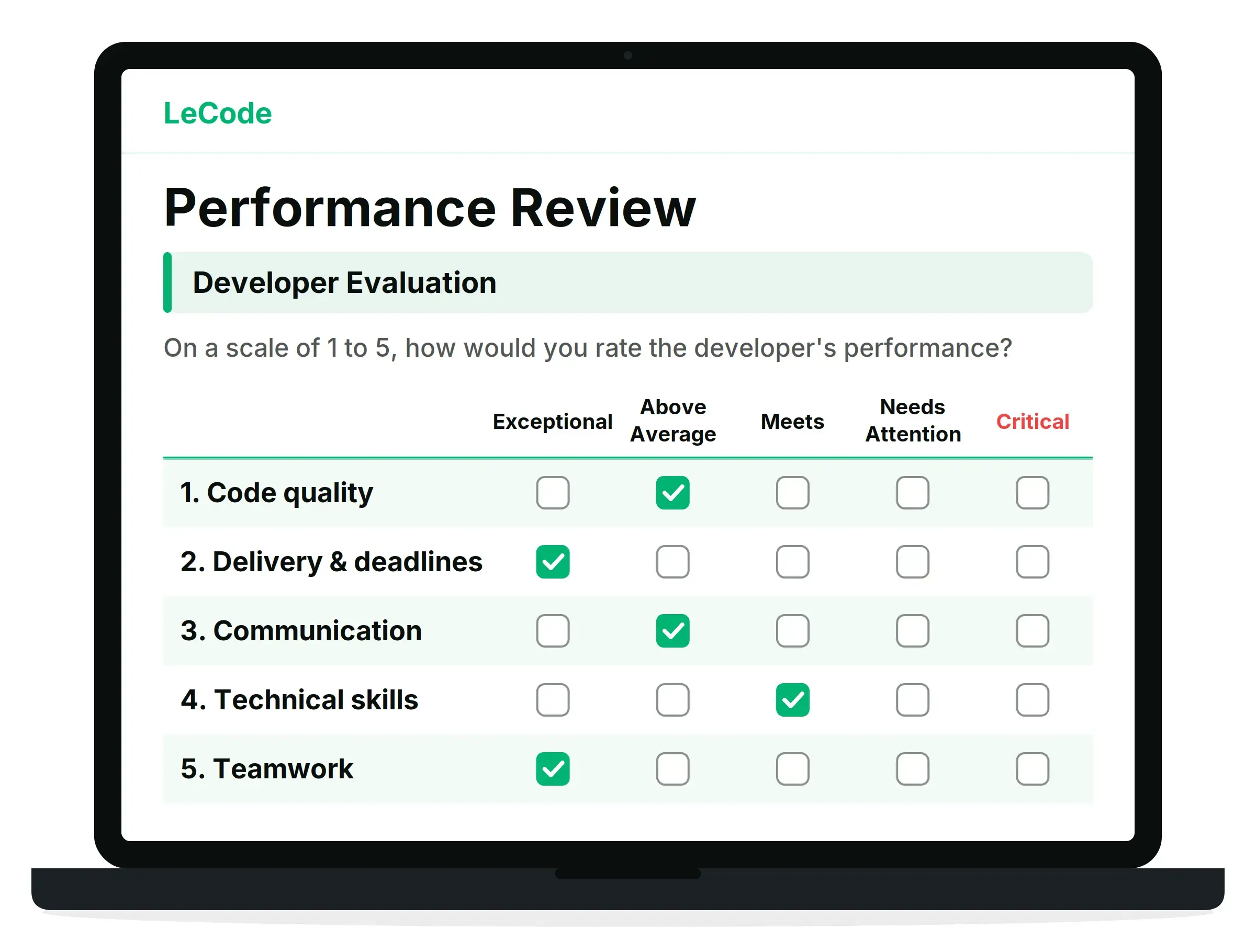
When you hire a developer, you want to be sure you are working with a professional who delivers results and continues to grow. As a developer, you want to know how you are progressing and what you need to improve to move forward in your career. At the end of the day, both questions lead to the same challenge: how do you fairly evaluate the performance of someone who writes code?
At LeCode, we created our own performance review methodology to answer that question. Clients can track the performance of developers working on their projects using clear criteria and actively participate in the evaluation process. Developers, in turn, know where they stand, where they can go, and what they need to do to keep developing.
In this post, you’ll find answers to:
- What is a performance review?
- Why is evaluating a developer different from evaluating other roles?
- How does LeCode evaluate its developers?
- What exactly is evaluated?
- What should you expect from a developer at each career level?
- Why is performance review good for the client, the developer, and the team?
What Is a Performance Review?
A performance review is a formal method for evaluating how well a professional is performing compared to what is expected from their role.
Many people confuse it with feedback, but they are different. Feedback is usually a specific conversation about something that happened. A performance review, on the other hand, is a structured methodology: it has defined criteria, happens in cycles, and looks at the entire period rather than just the most recent delivery.
The goal is not simply to give someone a score. It is to examine their strengths, identify areas for improvement, and, most importantly, define the next steps. Without this, a professional may receive feedback but still have no idea what to do with it.
Why Is Evaluating a Developer Different From Evaluating Other Roles?
In many jobs, it is easy to see the result of someone’s work. A salesperson, for example, can be evaluated based on the number of sales they closed during the month. With developers, it is different: much of their work is not immediately visible.
Before writing a single line of code, a developer needs to understand the problem, think through possible solutions, and plan. After that, they review their colleagues’ code, test what they built, and prevent bugs from reaching the customer. When this work is done well, the result is precisely that nothing goes wrong — and that can be difficult to see in a spreadsheet.
That is why metrics need to be used carefully. Counting lines of code or completed tasks may seem like a precise way to measure performance, but when the number itself becomes the main goal, people start working for the metric rather than for the actual outcome.
How Does LeCode Evaluate Its Developers?
At LeCode, performance reviews take place every six months, in January and July, combining two perspectives on the same work: the developer’s own perspective and the client’s.
- Self Review, weighted at 30%: the developer reflects on their own performance during the period.
- Client Review, weighted at 70%: the person who works closely with the developer on the project evaluates how the partnership performed.
Both complete the same form, giving scores from 1 to 5 for each question. At the end, there are three open-ended questions: what were the developer’s strengths, what do they need to develop, and whether there are any suggestions.
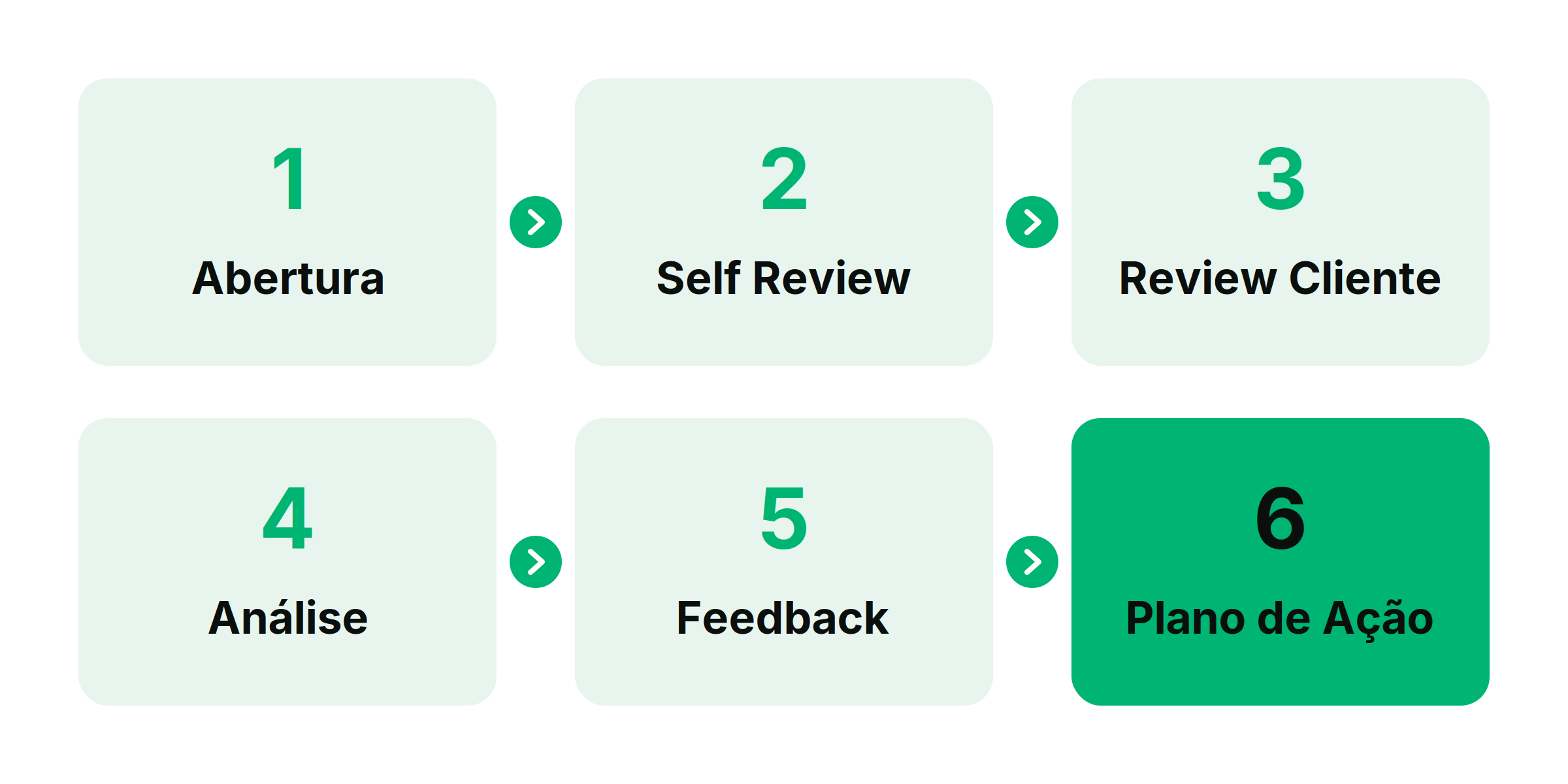
Each cycle follows six stages:
- Cycle opening
- Developer self-review
- Client review
- LeCode analyzes the results
- Feedback conversation with the developer
- Action plan for the next period
The evaluation does not simply stop until the next semester. Between cycles, the client has monthly check-ins with more informal feedback about day-to-day work. Developers can also request feedback at any time.
What Exactly Is Evaluated?
The review form looks at five dimensions of the developer’s work, each with a specific weight in the final score. For people outside the technical field, we translate each one into a simple day-to-day question:
| Dimension | Weight | In practice, the question about the developer is… |
|---|---|---|
| Technical Skills | 30% | Does the developer solve technical problems with quality, in an organized and efficient way, while constantly seeking to improve and stay up to date? |
| Delivery & Results | 25% | Does the developer meet deadlines and deliver what was agreed upon, completely and with few errors, while maintaining this standard over time? |
| Communication | 20% | Does the developer communicate clearly with both technical and non-technical people, keep everyone informed about the progress of their work, and respond well to feedback? |
| Collaboration | 15% | Does the developer share knowledge, support colleagues, and maintain a positive and respectful attitude, even when they disagree with the team’s decisions? |
| Autonomy & Initiative | 10% | Does the developer work independently, manage their time well, solve problems without constant follow-up, and suggest improvements? |
Notice one important detail: communication and collaboration together account for 35% of the final score. For us, being a good developer is not just about writing good code. It is also about working well with other people.
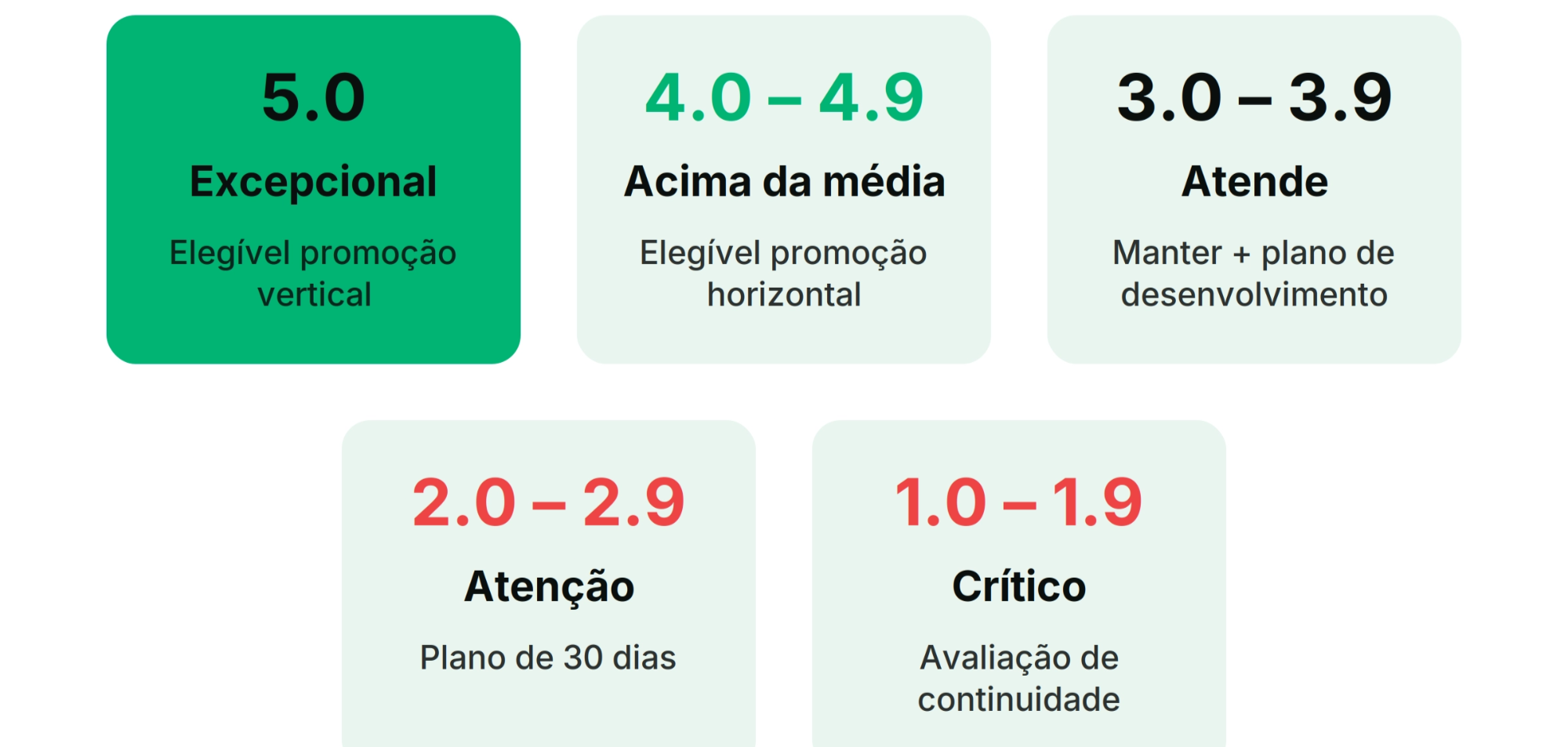
The scoring system is simple: 5 means exceptional, 4 means above expectations, 3 means meets expectations, 2 means below expectations, and 1 means unsatisfactory.
What Should You Expect From a Developer at Each Career Level?
At LeCode, every developer is assigned to one of seven career levels. Understanding these levels helps clients know what to expect from each professional and evaluate them fairly: it does not make sense to expect a junior developer to perform like a senior.
| Level | Experience | What the client can expect |
|---|---|---|
| Junior I | Up to 1 year | Completes tasks with guidance from someone more experienced and is learning how the project works. |
| Junior II | 1–2 years | Handles simple tasks independently but still needs support with more difficult ones. Begins reviewing colleagues’ work. |
| Mid-Level I | 2–3 years | Solves complex tasks independently and begins mentoring less experienced developers. |
| Mid-Level II | 3–4 years | Leads specific parts of the project and decides how they should be built. |
| Senior I | 4–6 years | Acts as a technical reference for the team and participates in important decisions about the system’s architecture. |
| Senior II | 6–8 years | Understands the system as a whole, and their decisions influence multiple teams or projects. |
| Tech Lead or Specialist | More than 8 years | Leads the team or acts as the main authority on a specific technical area. |
When evaluating a developer, the question is not “Is this developer good?” but rather “Is this developer delivering what is expected at their level?” A junior developer who frequently asks for help may be performing exactly as expected. A senior developer who requires constant supervision is not.
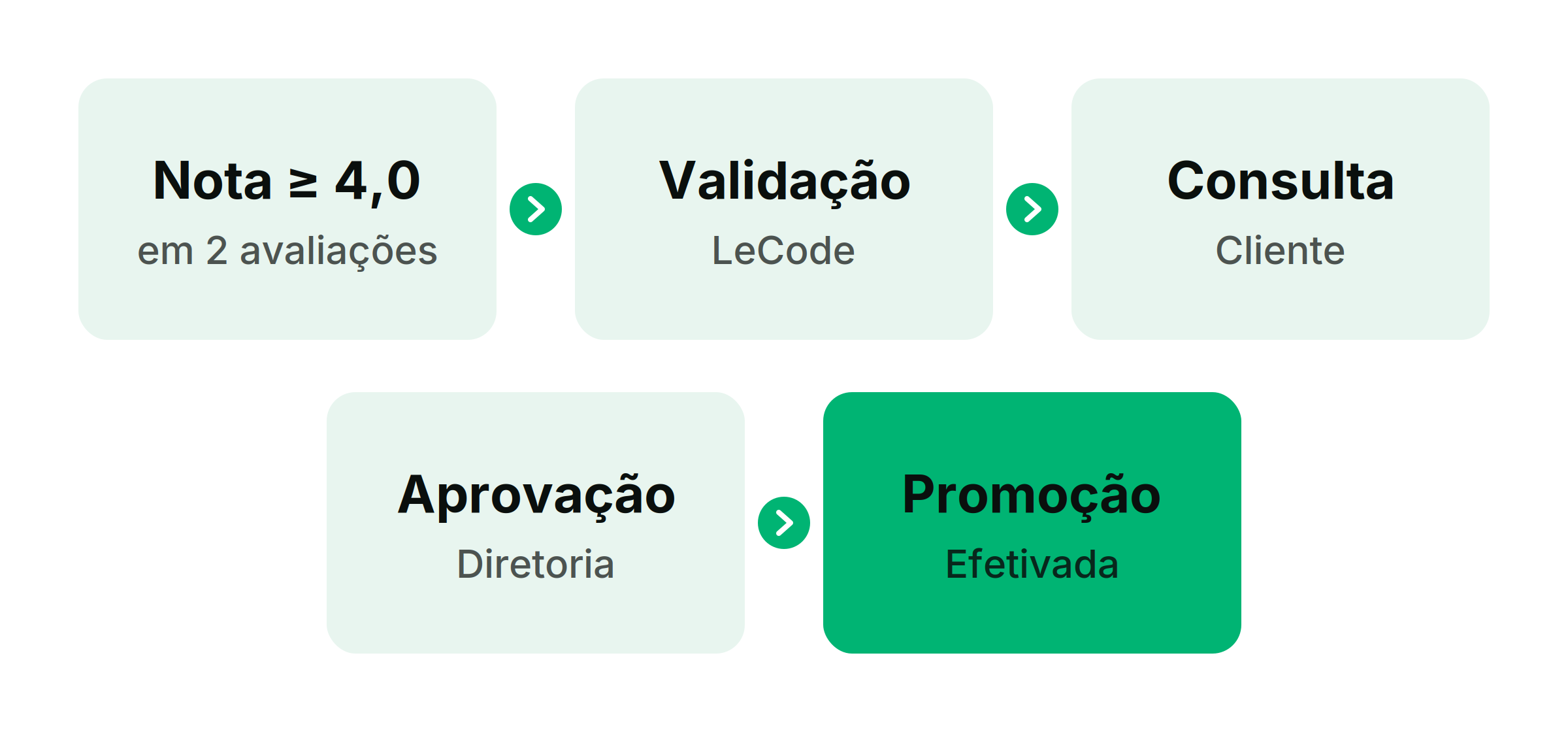
To move up a level, the developer needs a final score of 4 or higher in two consecutive reviews, at least 12 months at their current level, a positive recommendation from the client, and evidence that they already have the competencies expected at the next level. The promotion must also go through LeCode’s validation process, consultation with the client, and approval from leadership.
And when the score falls below expectations, the review also shows the path forward. A score between 3 and 3.9 results in a development plan, while a score between 2 and 2.9 results in a 30-day improvement plan with clear goals.
Why Is Performance Review Good for the Client, the Developer, and the Team?
Because clear criteria mean that decisions about a developer’s performance no longer depend on the opinion of a single person. As a result, the evaluation process brings benefits to everyone involved.
- For the client: they know what to expect from each career level and have clear criteria for evaluating performance. The project also improves with every cycle: the points identified during the review become an action plan, and the developer returns to the project better prepared. The result tends to be higher-quality deliveries, fewer errors, and smoother communication.
- For the developer: the review goes beyond setting a personal growth goal. Through the client’s feedback, the developer understands what matters most to the people hiring them and knows where to focus to deliver their best work on the project. Their progress is recognized along the way.
- For the team: continuous feedback and merit-based decisions create an environment of trust.
In the end, everyone benefits: the client has professionals who continue to grow within their project, while the developer has a clear view of their own progress.
Frequently Asked Questions
How often do I need to evaluate the developer?
The formal performance review takes place twice a year, in January and July. Between cycles, there are monthly check-ins, which are shorter and more informal conversations about the day-to-day work on the project.
I’m not a technical person. Can I still evaluate the developer?
Yes. Most of the review focuses on things you can observe in your day-to-day interactions: deadlines, delivery quality, communication, collaboration, and initiative. Together, these dimensions account for 70% of the score.
What happens if the developer isn’t performing well?
The review identifies what needs to improve and turns those points into an action plan. If the score falls below expectations, a development plan is created or, in more serious cases, a 30-day improvement plan with clear goals.
Do I participate in the developer’s promotion?
Yes. To be promoted, the developer needs a positive recommendation from the client, and LeCode consults you before any promotion takes place.
Can I give feedback outside the review cycle?
Yes, and you should. Continuous feedback is encouraged, and you can request a check-in at any time.
Conclusion
LeCode’s performance review was designed to ensure that clients and developers are moving in the same direction. Clients evaluate developers using clear criteria, know what to expect at each career level, and closely follow the development of the people working on their projects. Developers, in turn, receive concrete feedback on how to deliver their best work and know what they need to do to grow.
With every cycle, the review turns into an action plan. And the results show up directly in the project, with better and better deliveries over time.
Want developers reviewed with this level of care on your project? Talk to LeCode on our website.